Althea Gibson Broke Into Top Tennis With a Whole Community Behind Her
From the gift of a racket on Harlem courts to the 1950 U.S. Nationals, Althea Gibson rose with help from coaches, club members, the ATA and people who spoke up for her.

The lesson
Big doors often open because a whole community helps you get ready and speaks up for you.
- Build your skill in the places that welcome you now.
- Let people share what they have, from a racket to a club membership.
- Speak up for others, as people once spoke up for Althea.
The challenge
Althea Gibson was born on August 25, 1927, in Silver, South Carolina. Her tennis story began on the courts of Harlem in New York.
In a letter printed in 1951, Althea told how it started. Buddy Walker gave her a racket and introduced her to someone at the 150th Street Project House courts. That person connected her with Mr. Fred Johnson, a tennis teacher at the Cosmopolitan Tennis Courts. Althea said she was about 16 when the coaching began.
Members of the Cosmopolitan club helped her join and enter tournaments. She later recalled winning the girls' singles at the New York State Open in 1942.
The problem
Tennis was not open to everyone. Black players were shut out of many tennis routes run by white officials.
The biggest event in the country, the U.S. National Championships at Forest Hills, was not open to anyone who simply signed up. Players reached it by invitation. For a Black player, that door had stayed closed. No Black player had ever competed there.
Althea had the skill. What she needed was a way in.
What they did
First, she built a strong record where she was welcome. The American Tennis Association, or ATA, was founded in 1916. It ran competitions for Black players. It was a real championship circuit, with its own players, organisers and standards.
Althea won her first ATA women's singles title in 1947. Then she kept winning: ten titles in a row, through 1956.
She had another important helper. Her letter names Dr. R. Walter Johnson as a mentor and sponsor. He was a different person from her first coach, Mr. Fred Johnson. Dr. Johnson did wider work too, helping develop Black tennis players and the ATA's junior programme.
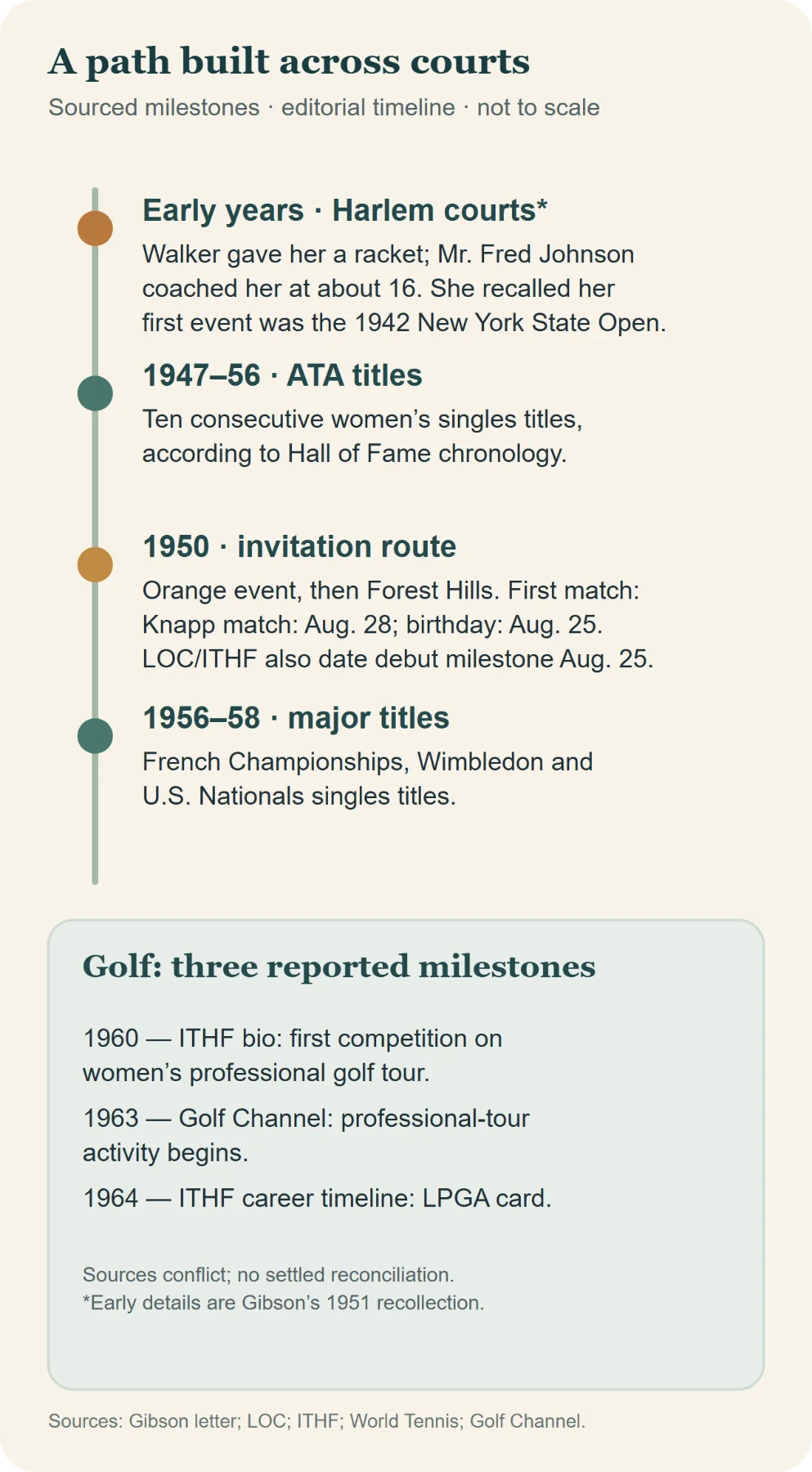
Key steps in her career. Some sources give her first big match the date of her birthday, August 25; match records say August 28.
In 1950, a route to Forest Hills opened. Althea played at a grass-court event in Orange, New Jersey, run by the Eastern Lawn Tennis Association. From there, she received an entry to the Nationals.
People spoke up for her. In July 1950, the former champion Alice Marble wrote in the magazine American Lawn Tennis. She argued in public that Althea should be allowed to compete. A later tennis history also credits pressure from Marble and from another supporter, Edward Niles. It describes talks between the national tennis association and the ATA. Many people helped open the door, not just one.
What happened next
On August 28, 1950, Althea won her first-round match against Barbara Knapp, 6–2, 6–2. She became the first Black player to compete in the U.S. National Championships. Some accounts give the date as August 25, but that was her birthday.
In the second round, she faced the defending champion, Louise Brough. It was close. Rain stopped play with the match at one set each, and Althea ahead 7–6 in the final set. When play started again, Brough won, 1–6, 6–3, 9–7.
Althea kept going. In 1951, she became the first Black woman to play at Wimbledon. In 1956, she won the French Championships singles title. In 1957 and 1958, she won both Wimbledon and the U.S. National Championships. She also won doubles titles with partners including Angela Buxton and Darlene Hard.
Winning did not end the unfair treatment. In 1957, Time magazine reported that she still lacked official standing with the national tennis association. It also described how she was treated at Forest Hills.
After tennis, Althea took up professional golf. Sources give different starting points: 1960, 1963 and 1964.
Her story inspires because she worked hard inside a community that shared what it had. Coaches, club members, a tennis association and public voices all helped. Effort alone does not open every door. But skill, built with others and backed by people who speak up, can change who gets to play.
Try this today
- Write down one skill you can practise in a place that already welcomes you. Spend 10 minutes on it today.
- Think of someone who once "handed you a racket," like Buddy Walker did. Send them a short thank-you message.
- Find one small way to speak up for someone else this week. Set a reminder with your companion so you follow through.
Who are the people helping you get ready, and who could you help in return?
Sources for this story: S01, S02, S03, S04, S05, S06, S07, S08. Full list below.