Misty Copeland Started Ballet Late, in a Free Class. She Rose to Principal Dancer.
A free class, a teacher's scholarship and practical help from several adults turned Misty Copeland's late start into a career that made her American Ballet Theatre's first Black woman principal dancer.
The lesson
A late start can still lead far when you say yes to the chance in front of you.
- Try the free or small chance that is within reach.
- Notice the practical help that keeps you going, like a ride, a room or a paid fee.
- Once you are inside, help widen the door for the next person.
The challenge
As a child, Misty Copeland went to the Boys & Girls Club in San Pedro, California. She later described it as one steady place in an unsettled childhood. She recalled joining the club at about age seven and finding guidance and mentors there.
In middle school, she was on a dance team. She said her dance-team coach noticed her dancing and suggested she try the club's ballet class.
The class was free. It was taught once a week by Cynthia "Cindy" Bradley. Misty was 12 or 13 when she started; sources disagree on the exact age. Either way, that is a late start by the standards of professional ballet.
The problem
At first, Misty watched from the bleachers. Then Bradley invited her to the barre. After seeing her in class, Bradley offered her a full scholarship at her own studio.
But a scholarship did not fix everything. In a 1999 newspaper profile, Misty's mother described a two-hour bus trip each way to the studio. She said the trip made the lessons hard to keep up.
Home life was not steady either. Misty has recalled periods of moving between friends' homes and motels. She has said she is not sure of all the dates.
What they did
The adults around her found a way for training to continue. The 1999 profile reports that Bradley asked whether Misty could live with the Bradley family for a while. Misty stayed with them and shared a bedroom with the Bradleys' young son.
Other people helped too. A couple, Liz and Dick Cantine, helped pay some of her dance costs. Misty also went to summer programmes on scholarship.
Misty did the work. In 1998, at age 15, she won the Music Center Spotlight Award in Los Angeles. She had trained in ballet for less than three years. She beat more than 60 other dancers, and professional companies began to notice her.
That same year, a family conflict reached the courts. Newspapers reported that her mother sought a restraining order against the Bradleys. Misty had asked the court to make her legally independent. The adults had very different views about her training and her home.
By September 1, her mother had dropped one request. Misty told the judge she wanted to stop her own case, and the judge dismissed the restraining-order requests. The news reports do not give every person's full story.
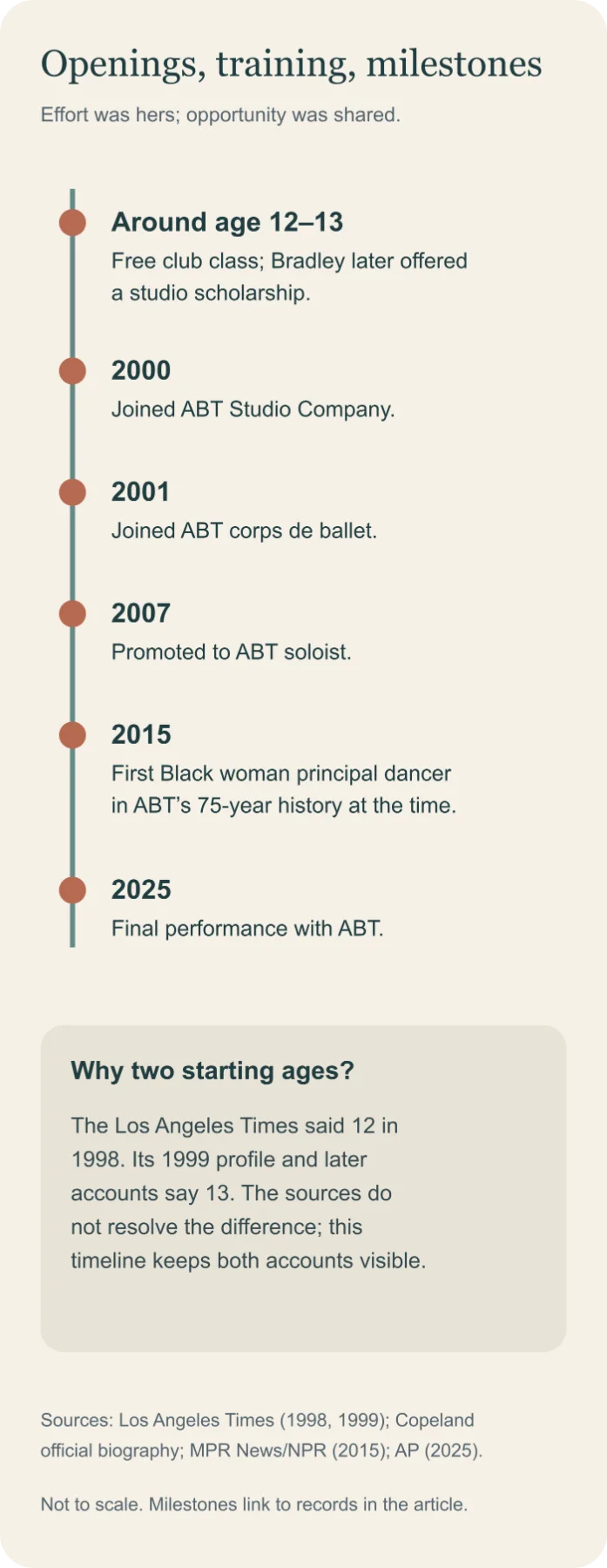
Key steps in her career. Sources differ on whether she was 12 or 13 at her first class.
What happened next
In 2000, Misty joined American Ballet Theatre's Studio Company. In 2001, she joined the main company's corps de ballet, the group of dancers who perform together. In 2007, she became a soloist.
In June 2015, the company made her a principal dancer, its top rank. She was the first Black woman principal dancer in its 75-year history.
The barriers did not vanish. Misty has said she was the only Black woman dancer at the company for her first ten years there. She has spoken about ballet's makeup and costume habits, including white makeup in some roles, and how they affect Black and brown dancers.
She also found a guide from an earlier generation. Raven Wilkinson was a Black ballerina who had faced racial barriers decades before. Misty has said Wilkinson's example and their relationship helped her understand her own place in ballet.
On October 22, 2025, Misty gave her final performance with the company at a gala. She had been with it for about 25 years. She continues to write and to work for more diversity in dance.
Her story inspires because it started so small: a free class in a community club. Then a coach's tip, a teacher's scholarship, a place to stay and patrons' support kept the door open. Her own hard work counted, and so did all that help. Not every late start leads to fame, but a small open door can be worth walking through.
Try this today
- Look for one free or low-cost class, group or club near you that matches something you want to learn. Write it down.
- List one practical thing that would make your next step easier, like a ride, a quiet room or a fee paid. Ask one person about it.
- Think of a coach or teacher who once pointed you toward something new. Send them a short thank-you message.
What small door is open to you right now?
Sources for this story: S01, S02, S03, S04, S05, S06, S07, S08, S09, S10. Full list below.