Domitila Barrios de Chungara Learned, Organised and Spoke Up Alongside Mining Families
In Bolivia, with help from her father, a teacher and a miners' Housewives' Committee, Domitila Barrios de Chungara finished school, became a leader and joined a protest four women began.

The lesson
Your voice grows stronger when you learn, meet and act together with others.
- Accept small, practical help, like school supplies or someone asking where you have been.
- Join a group that is already doing the work, and take on a role in it.
- When you speak, speak for the people beside you as well as yourself.
The challenge
Domitila Barrios de Chungara came from Bolivia. Sources disagree on whether she was born in Siglo XX, a mining community, or in Pulacayo.
Her father encouraged his daughters to study. That mattered, because school was hard for Domitila to reach and to keep.
The problem
According to a Bolivian government timeline, Domitila started school late. Then her schooling kept being interrupted. She had family members to care for, and the family had little money.
For a girl in that situation, finishing school was far from certain.
Later, as an adult, she joined a group of mining families. But for a time she stopped going to its meetings.
What they did
Domitila had help at school. The government timeline says a teacher helped her with school materials. With that help, she finished her studies in 1952. The timeline does not name the teacher.
In 1957, Domitila and René Chungara returned to Siglo XX. At Siglo XX, miners' families built a Housewives' Committee through their shared work. One account says it was created in 1960. A memoir by Gerónima Jaldín dates an organising meeting to June 21, 1961. These may be two different stages; the exact founding story is not settled.
The timeline says Domitila attended the committee from 1963. When she stopped going, a labour organiser named Federico Escóbar asked why. He also helped her see that work done at home has real economic value.
In 1965, the committee elected her secretary general. She now helped lead a group that others had started.
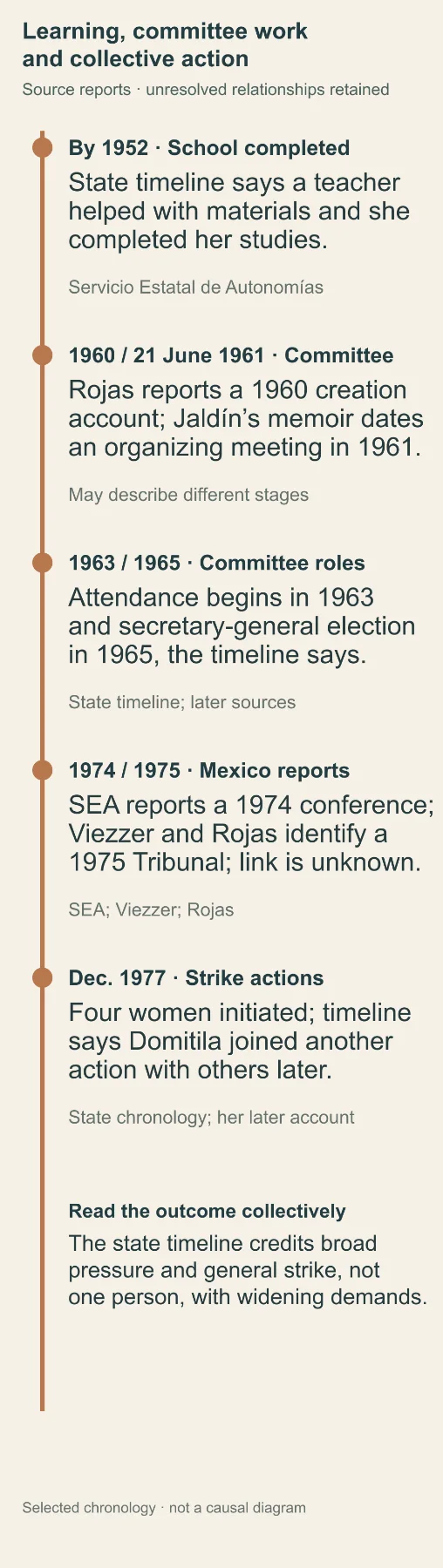
Key dates in her work. Sources differ on when the committee began, and on whether her Mexico trip was in 1974 or 1975.
She also carried the group's voice abroad. In 1975, she represented the Housewives' Committee of Siglo XX at an International Women's Year Tribunal in Mexico. A government timeline instead reports a 1974 conference in Mexico; it is not clear if these are the same event.
Her life story became a book, Let Me Speak!, made with the help of a collaborator, Viezzer. In its preface, Domitila asked readers not to see it as only one person's story. She tied her life to her people, and she said others had done more than she had.
What happened next
On December 28, 1977, four miners' wives began a hunger strike. They were Nelly Colque de Paniagua, Aurora Villarroel Lora, Luzmila Rojas Pimental and Angélica Romero Flores.
On the third day, Domitila and other women joined in with a separate action at the newspaper Presencia. In her own later account, she described how "we" carried out a 21-day strike.
A general strike and wide public protest added to the pressure. The government timeline says the authorities then accepted the demands. No single person won that result. It came from many people acting together.
The ending was not perfect. Domitila later criticised the kind of democracy that was built on the movement's struggle.
Years later, in a 2006 interview, she spoke about fear. She also spoke about her father's influence. And she said she drew strength from the people who were waiting for her.
Her story inspires because she did not treat her voice as hers alone. A father, a teacher, a committee, an organiser and the four women who began the strike all shaped what she did. Change is never certain. But people who learn and act together can move what one person cannot.
Try this today
- Think of one group near you that is already working on something you care about. Write down one small way you could take part.
- If you have drifted away from something good, like a class or a group, send one message to reconnect. Set a reminder with your companion.
- Thank someone who once gave you practical help, like the teacher who gave Domitila school supplies.
Who are the people waiting for you, and how could you show up for them this week?
Sources for this story: S01, S02, S03, S04, S05. Full list below.